Blog / News
- HOME
- About
- Blog / News
The recent film The King's Warden leaves a deep and lingering impression. Although King Danjong has been dethroned and is no longer a ruler, to Eom Heung-do, the village head who protects him, he remains both a "king" and a child-like figure to be cared for. The film calmly portrays the heavy burden of living alongside an unpredictable presence, where one must fully bear the consequences of that presence's decisions. This subtle tension and sense of responsibility closely mirror the reality we face today when encountering "AI agents" in the enterprise field.
At present, the industry is swept up in an AI agent frenzy; the fear of missing out (FOMO) is palpable, as if staying still means falling behind. However, from my perspective—having spent over 30 years in IT, cloud, and enterprise software—what we need right now is not the speed of chasing trends. We must look back and ask: Do we accurately understand what an AI agent is? How will we apply them to corporate tasks? And is the organization truly prepared to handle them?
Generative AI, particularly Large Language Models (LLMs), has made AI appear as if it possesses the ability to think and speak. I say "appear" because it remains unclear whether these models are truly reasoning or simply combining data probabilistically. AI agents stand on this ambiguous boundary, evolving from entities that merely "respond" to those that actively "act."
Generally, an AI agent operates by receiving a user's request, interpreting the intent, and utilizing tools (such as MCP servers) to establish and execute a plan. It moves through four stages: Observe, Think, Decide, and Act. Enterprise leaders must focus on the "Act" stage, as execution implies authority, and authority inevitably entails responsibility. While minor inaccuracies might be tolerable in public or commercial AI for personal convenience, AI-driven decisions in financial, public, and corporate environments fall under the strict domain of audit and regulation. Therefore, before adoption, we must first define the "scope of delegation" we are prepared to handle.
Having led enterprise software development, mainframe modernization, and cloud transformation for many years, I see a fundamental shift. While past systems were "deterministic," operating under fixed rules, the environment led by AI agents is "probabilistic." In areas dealing with core corporate assets and data, a "Sovereign AI" perspective is essential. Only when a company maintains sovereignty and control over its AI can it entrust the agent with critical tasks. This is akin to Eom Heung-do’s effort to protect Danjong within the established order of the village.
In the software development field, the use of AI agents—LLMs trained on code—is expanding exponentially. AI now generates code, conducts tests, and even resolves bugs. Here, I am reminded of the "Shift Left" strategy we have long emphasized. Just as we move testing to the earliest stages to ensure quality, AI can provide a scaffolding (draft) of the code to save developers time and broaden their cognitive horizons. However, it remains to be seen whether enterprises can fully trust "generative work software"—where agents generate and execute tasks on the fly—over traditional "packaged/pre-built software or COTS software" (on-premises or SaaS).
For example, if an agent analyzes and reports data from an ERP system, it is a welcome advancement. But if the agent independently decides data values and alters the content of reports being sent to branch offices, it moves beyond a technical issue into the realm of "delegation and trust." Consequently, rather than completely replacing existing software, the current trend suggests that AI agents will become a powerful "feature" within software products, supporting and augmenting the user.
Ultimately, an AI agent is neither a silver bullet nor a passing fad. In an enterprise environment, an agent is an entity that should be granted authority only to the extent the organization can manage, supported by a clear accountability structure. The judgment today’s CIOs and CTOs must make is not the technical choice of "whether to use an AI agent." Instead, it is: "What kind of agent is our organization prepared to live with?" Aiming for "adoption first" without this preparation is like bringing a king into a village to solve problems without even knowing who that king is.
In the film, Eom Heung-do did not control the king, yet he silently took responsibility for the consequences of the king’s presence with his own life. To a prepared organization, an AI agent will be an irreplaceable competitive advantage; to an unprepared one, it may become an unpredictable and dangerous ruler.
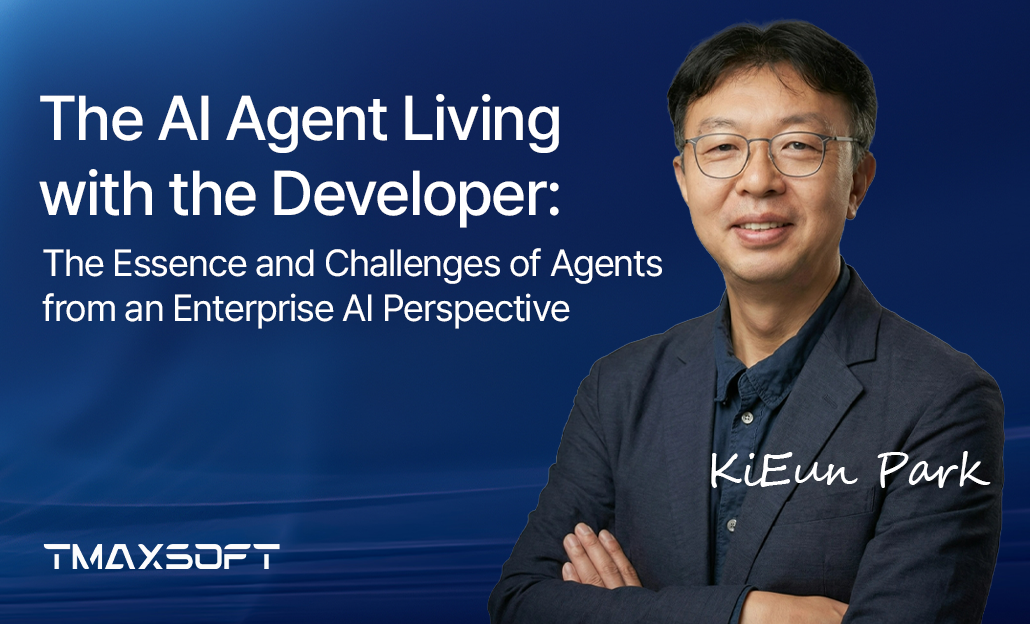
*This article is an English translation of an op-ed by KiEun Park, CTO (EVP) of TmaxSoft, originally published in Electronic Times on March 30, 2026.
Original op-ed: [기고]왕과 사는 남자, 개발자와 사는 AI 에이전트: 엔터프라이즈 AI 관점에서 본 에이전트의 본질과 과제 - 전자신문